

In a volatile short‑term rental market, revenue performance no longer hinges on simply filling calendars. It depends on how well pricing, demand, and conversion work together as a system. That was the central takeaway from “The Perfect Trifecta for Short‑Term Rental Success,” a webinar featuring Chris Walker (Direct Booking Tools), Jason Gann (RevMax), and Robyn Scott (Bluetent).
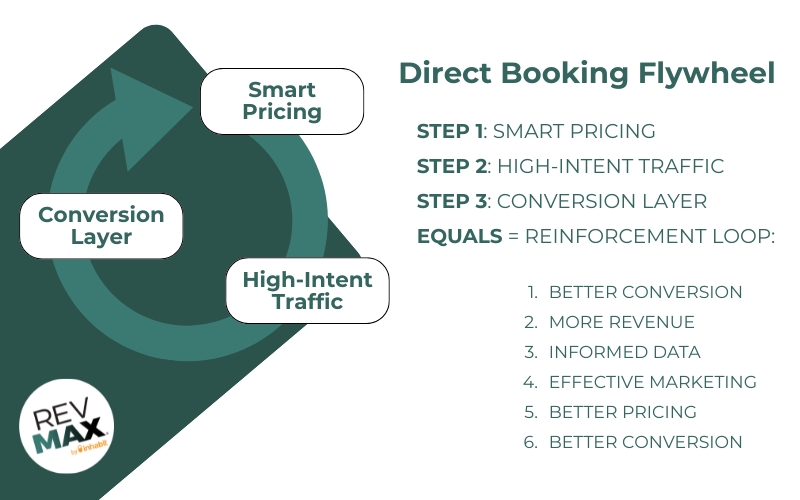
The session introduced the Direct Booking Flywheel, a revenue framework that places pricing at the center of sustainable growth. When pricing is misaligned, even strong marketing and a modern website fail to deliver results. When pricing is right, everything downstream performs better.
Watch the Full Replay
The Hidden Revenue Leak: Pricing Inefficiency
The discussion opened with a common issue across property management portfolios: pricing decisions are often static in a dynamic market.
Revenue leakage occurs when:
- Rates lag behind real‑time demand signals
- Operators underprice to protect occupancy
- Overpricing suppresses conversion and booking velocity
The panel emphasized that pricing inefficiency impacts more than your nightly rate. Click‑through rates, booking confidence, length of stay, and total revenue per booking are all affected by pricing misalignment.
Pricing as a Conversion Lever, Not Just a Revenue Lever
One of the most important reframes from the webinar was that pricing is not just a yield tool—it’s also a conversion tool.
Accurate, market‑aligned pricing:
- Improves competitiveness in search results
- Reduces guest hesitation during the booking process
- Minimizes OTA “price‑check” behavior
- Supports marketing performance by increasing qualified demand
In short, pricing intelligence improves both revenue and conversion efficiency, reinforcing its role as the first step in the flywheel.
The Direct Booking Flywheel in Action
The presenters outlined a four‑step system:
- Smart Pricing: Real‑time rate intelligence keeps properties competitive without constant manual intervention.
- High‑Intent Traffic: When pricing is right, marketing attracts better‑qualified guests who are more likely to book.
- Conversion Layer: Transparent pricing, comparison tools, and trust signals prevent leakage back to OTAs.
- Reinforcement Loop: Better conversion leads to more revenue, which fuels more marketing, better data, and even smarter pricing.
When these elements are aligned, performance compounds instead of plateauing.
Demand Visibility Changes Revenue Outcomes
The webinar also highlighted the importance of forward‑looking demand data. Specifically, the panelists shared insights into how often guests consider booking but ultimately don’t convert.
Understanding quote behavior allows revenue teams to:
- Identify missed demand earlier
- Adjust pricing before occupancy drops
- Optimize length‑of‑stay and gap‑night strategies
- Capture incremental revenue through add‑ons and protections
Before vs. After: Revenue Alignment at Scale
Before Alignment
- Static pricing in a dynamic market
- Inconsistent conversion despite healthy traffic
- Limited visibility into guest intent
After Alignment
- Pricing that meets demand in real time
- Higher direct booking conversion rates
- Improved booking windows and stay patterns
- Measurable gains in total portfolio revenue
Final Takeaway for Revenue Leaders
Revenue growth doesn’t come from pricing alone—but pricing sets the tone for everything else. When pricing, marketing, and conversion operate as a unified system, direct booking performance improves predictably and at scale.
If you’re ready to upgrade your pricing strategy—schedule a demo with the experts at RevMax today!